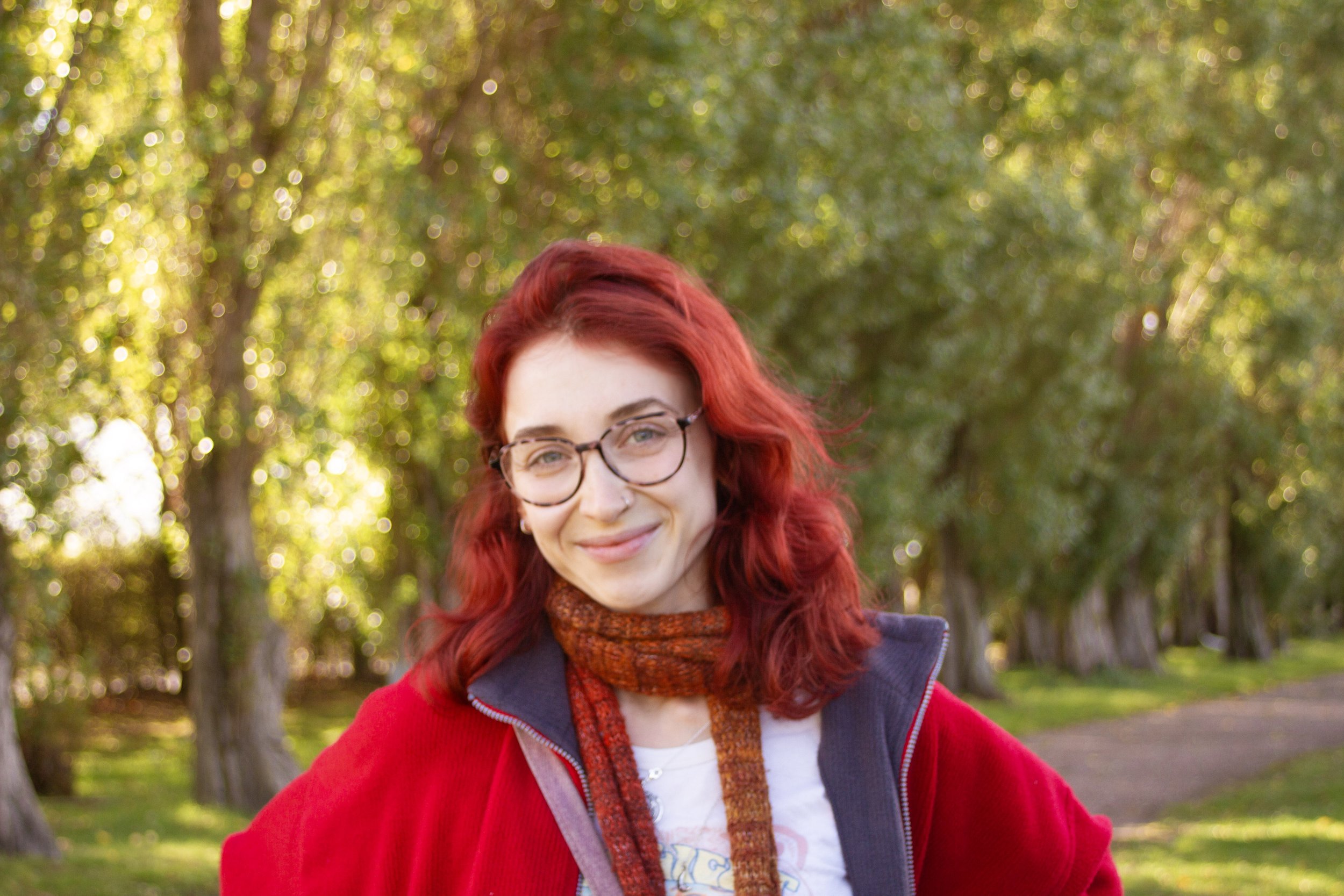
Hi, I’m Frankie
I am a BACP-registered Psychotherapeutic Counsellor, and UKCP-registered trainee integrative psychotherapist practicing in Oxford.
I hold 10 years' experience working relationally to support a diverse range of experiences across community, residential and mental healthcare settings. Although my therapy practice focuses on supporting queer and/or neurodivergent individuals, I welcome all enquiries.
Considering therapy?
Life can be intense and overwhelming at times; we can feel lost, stressed, discouraged, hopeless and stuck, unable to move forward on our own. Whatever has brought you here might be new to you, or might be something that seems to stick around or recur in your life.
People undertake therapy for any number of reasons - including (but certainly not limited to) a sense of generalised anxiety, life transitions, work stress, questions and concerns about identity, relationship difficulties, or something else altogether. Sometimes how we feel internally can be quite different to how others experience us in our day-to-day lives.
Whatever your circumstances, reaching out for therapy offers new possibilities – and it involves risk and vulnerability. Whether you’ve tried therapy before or not, it’s completely understandable to have mixed feelings about starting out, and to take things at a pace that works for you.
If you feel like you might like to have an initial chat, please feel welcome to drop me a line, and we can talk about what has been going on for you. More information on what to expect can be found in "what therapy looks like" below.

My Practice

-
I pay close attention to how identity, background, experience and social/economic context shape our experiences and interactions with the world (and vice versa). My practice does not shy away from the realities, anxieties and complexities of inequality, rapid technological change, AI proliferation, societal pressures, online and digital culture, identity crisis, ecoanxiety, financial strain and more.
I am also curious about the messages we might internalise from the world around us - consciously or unconsciously - from our families, cultures, the media, our identities, and the experiences we’ve had throughout our lives. Some messages can help us feel secure and connected, while others can leave us feeling conflicted, ashamed, or disconnected from ourselves. Therapy can create space to gently unpack these experiences and explore different ways of understanding ourselves.
The experiences of being alive can be messy and painful but also deeply rewarding, and each individual will experience this in their own way. At the same time, it can be easy to feel alone in some of the experiences that make us human, particularly where shame and isolation are involved – but these experiences are rarely as unique as they might feel from the inside. I believe that, whilst independence can be an empowering and nourishing experience, we also need relationships to thrive throughout all life stages.
-
I am a queer therapist, and work according to a queer, kink and poly-affirming/informed, sex-positive ethos. I aim to work in a way that doesn’t rely on assumptions about identity, relationships, or experience. I am a queer therapist, and work according to a queer, kink and poly-affirming/informed, sex-positive ethos. I aim to work in a way that doesn’t rely on assumptions about identity, relationships, or experience.
-
I am passionate about supporting neurodivergent individuals (including those with ADHD, Autism, dyslexia and more).
When working with neurodivergent individuals, I consider accessibility, needs profiles and how someone’s neurodivergence might shape their experience of environments, and being in the world (including and particularly relationships, jobs, home, and someone’s sense of themselves).
I draw on study and personal/professional experience to hold in mind some of the social, emotional and economic conditions that neurodivergent people may be more likely to experience.
I am committed to continuous reading and research, and I am informed by the social model of disability.
-
Beyond counselling, I have nine years' full-time experience working relationally and in caring roles across various settings, including residential care, education, supported housing, youth and grassroots organisations, and I possess extensive trauma-informed care experience. I have several years of coaching, mentoring and psychoeducation experience.
-
I hold a BSc in Psychology from the University of Reading, a Foundation Certificate in Counselling and Psychotherapy from Regents University, and a PgCert (L5) and PgDip (L6) equivalent and MSc (L7) in Counselling and Psychotherapy from the University of Warwick.
In my Psychotherapy training, I trained for 5 years at Postgraduate level, involving 450+ clinical placement hours, supervision and 160+ hours of my own personal therapy.
I am trained in Safeguarding to DSL level (L3), and have trained in dyadic developmental (L1) and trauma-informed practice.
Questions? You are welcome to reach me here:
I aim to reply within two business days.